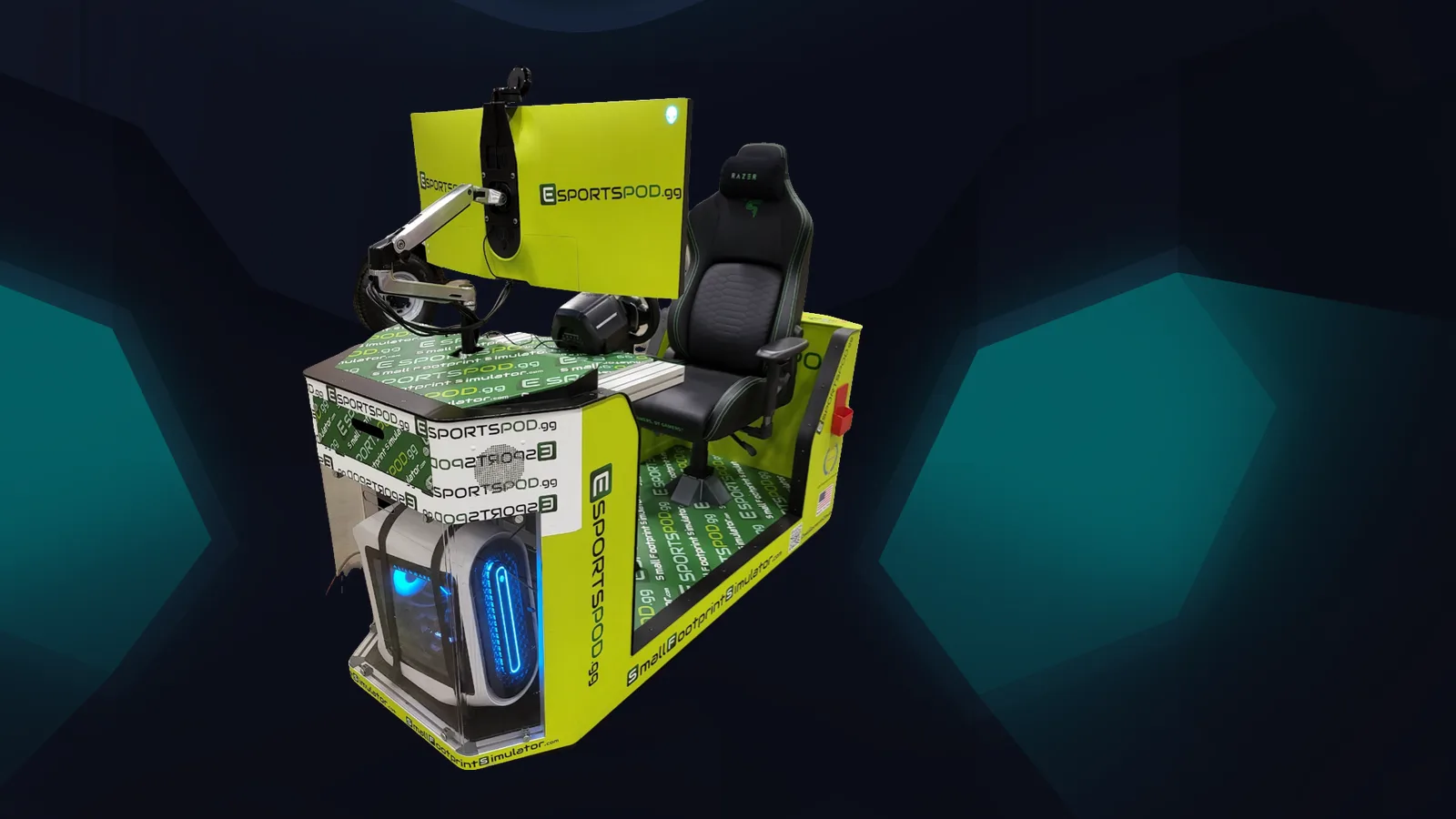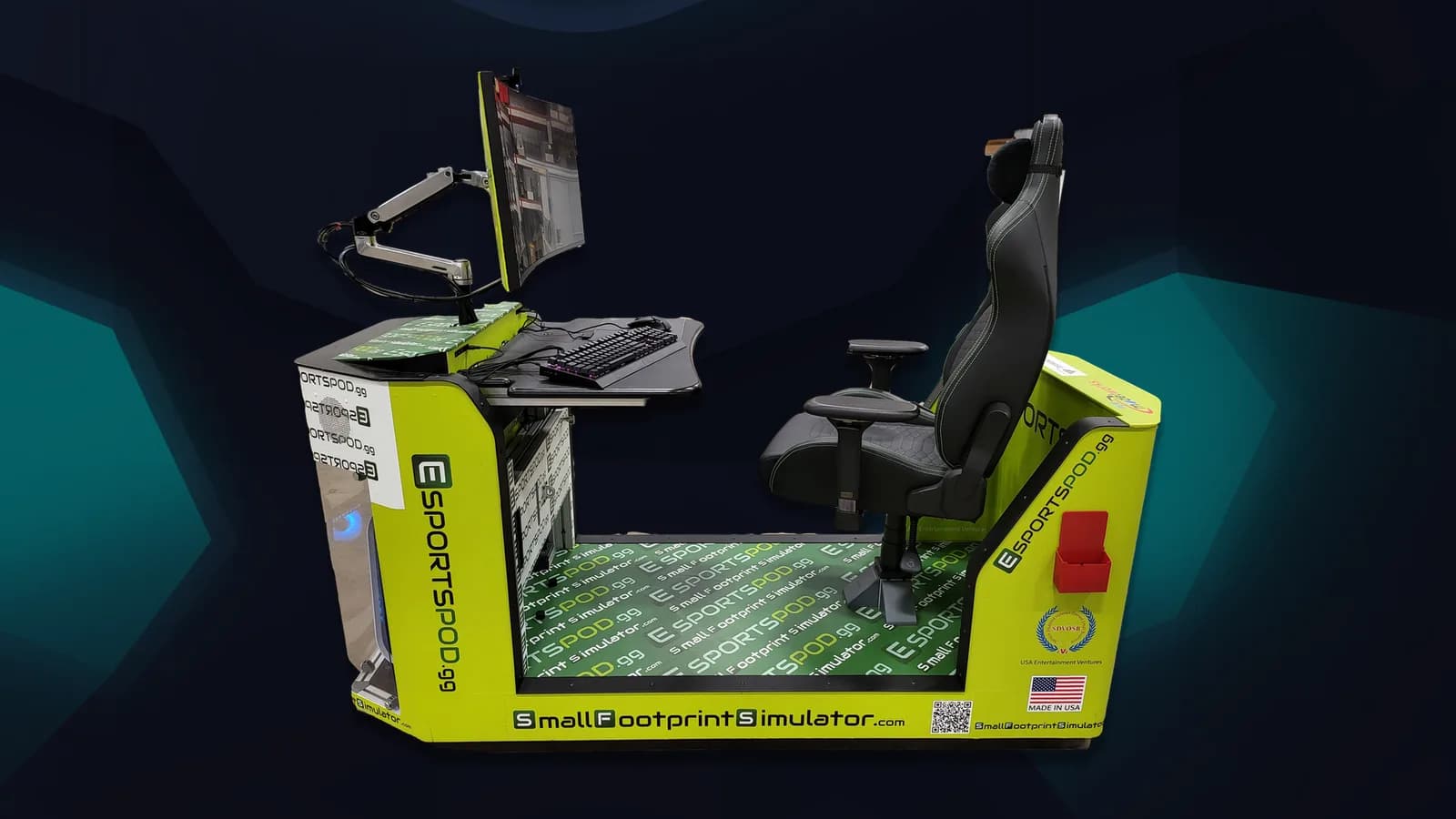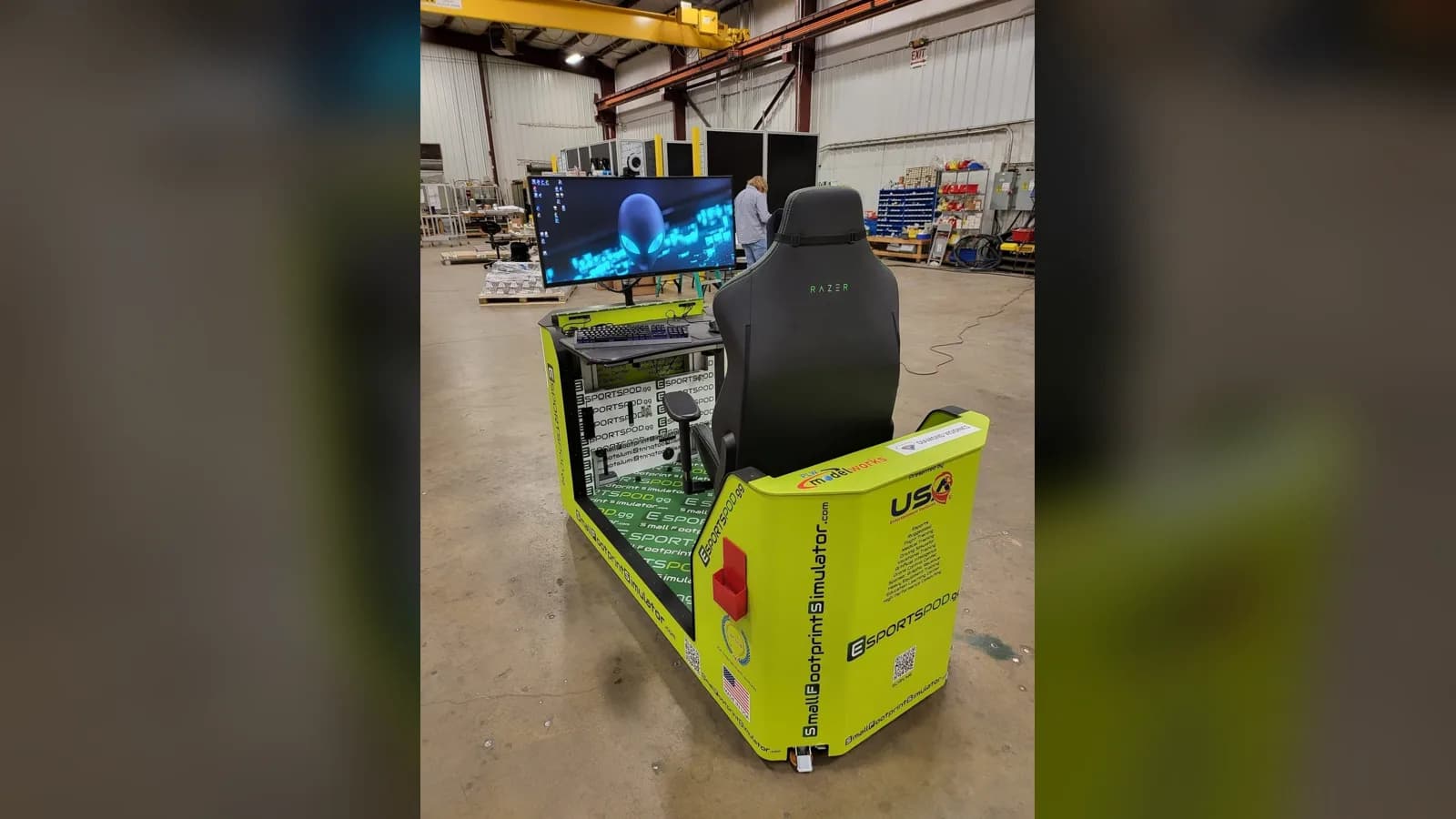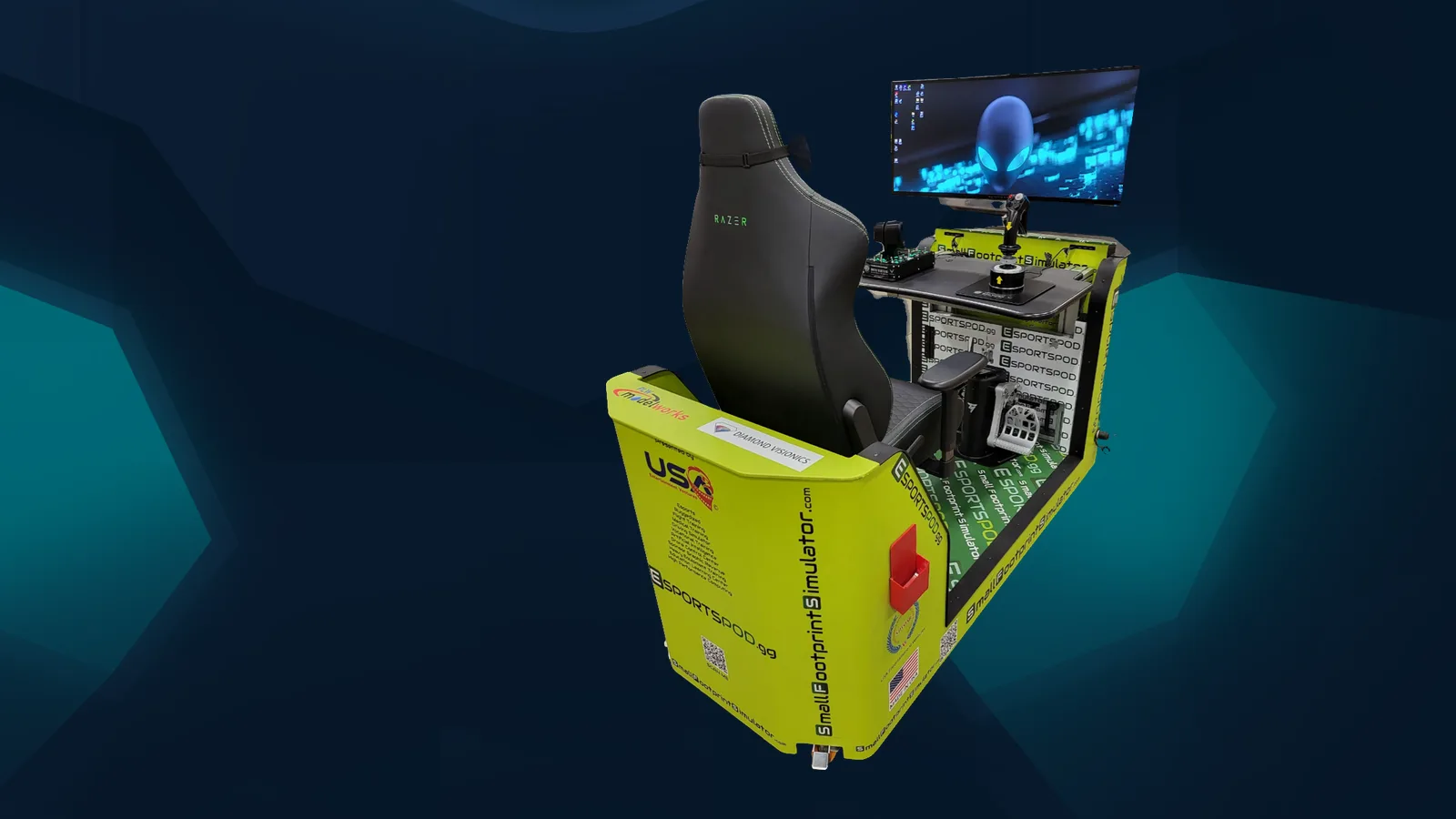
An Esport Pod by Sports Media, Inc. is a single-seat gaming and simulator station with an Alienware gaming PC, an Alienware 38-inch curved monitor, a Razer chair, headset and camera, and a Thrustmaster wheel or flight controls. Everything arrives installed in one rolling unit, so there is no parts list to assemble. Here's what each piece is and why we picked it.
Key takeaways
- Every pod ships with identical hardware, so one pod behaves like the next.
- The display is a 38-inch curved Alienware AW3821DW (3840x1600, 144 Hz, 1 ms).
- Razer supplies the chair, headset and streaming camera.
- Thrustmaster T248 RS GT wheel, pedals and shifter, or flight controls, handle simulation.
- Optional HTC Vive Pro Eye VR adds immersive training and play.
What PC runs inside an Esport Pod?
Each pod runs an Alienware gaming PC. It's a purpose-built gaming machine, not a repurposed office desktop, which matters when you ask a classroom to run competitive titles and simulators all day.
The pod also includes a modem and built-in Wi-Fi, so the unit can get online without a separate networking project. IT leads tend to like that part. It's one device to inventory instead of a pile of loose components.
Because every pod ships with identical hardware, troubleshooting is simple. If one station misbehaves, you compare it to its twin rather than guessing what's different.
What monitor does the pod use?
The pod uses an Alienware 38-inch curved monitor, model AW3821DW. It runs at 3840x1600, 144 Hz, with a 1 ms response time.
That's a lot of screen for a single seat. The curve and width fill your field of view, which helps in racing and flight simulation where peripheral vision carries real information. The 144 Hz refresh rate makes motion look smoother in fast shooters and sports titles.
There's also a projector slot that mirrors the screen to a classroom wall. A coach can run a scrimmage on the pod while a room of students watches the same image. That makes the pod useful for teaching as well as playing.
Which peripherals come with it?
The pod includes a Razer Enki chair, a Razer Kraken V3 HyperSense headset and a Razer Kiyo streaming camera. Together they cover comfort, audio and broadcast.
- Razer Enki chair: built for long sessions, which matters when a practice runs past the bell.
- Razer Kraken V3 HyperSense headset: team voice chat plus haptic feedback in supported games.
- Razer Kiyo camera: lets students stream or record without extra gear.
The camera is easy to overlook, but it's what turns a practice session into content a program can share. That connects to the media side of the program, which we describe on our sponsorship page.
What simulation hardware and VR are available?
For driving, the pod uses a Thrustmaster T248 RS GT wheel, pedals and shifter. Flight controls are available for aviation work, and an HTC Vive Pro Eye VR headset is optional.
Optional add-ons are priced separately: VR is $1,499, the T248 wheel set is $599.99 and the TSS handbrake is $285. If your program is mostly competitive gaming, you may skip some of them. If you're building a CTE pathway around racing or aviation, they're worth planning in from day one.
How is it all packaged?
The whole station rolls on wheels, fits through standard doors and into elevators, and runs on a standard 110V outlet. It has a small footprint and one seat.
That means you can store it in a closet, wheel it into a classroom, and plug it into the wall. No electrician, no dedicated room. Pods are sold in deployments of 10, 20 or 30, and each deployment includes installation, training and sponsorship support from Sports Media, Inc. The full lineup is on our products page.
Frequently asked questions
Are all Esport Pods configured the same way?
Yes. Every pod ships with identical hardware, including the Alienware PC, the 38-inch curved monitor, the Razer peripherals and the Thrustmaster controls. That consistency simplifies training, maintenance and fair practice, since students sit down at the same setup every time they use any pod.
Does the pod include a wheel and VR?
The pod supports a Thrustmaster T248 RS GT wheel, pedals and shifter or flight controls. The T248 wheel set is $599.99, and the optional HTC Vive Pro Eye VR headset is $1,499. A TSS handbrake is available for $285 if you want one.
Does it need special wiring?
No. The pod runs on a standard 110V outlet and includes a modem and built-in Wi-Fi. It rolls through standard doors and into elevators, so most schools can place it in a classroom, library or lab without construction or electrical upgrades.
What does a deployment include besides hardware?
Deployments of 10, 20 or 30 pods include installation, training and sponsorship support from Sports Media, Inc. Pricing is $300,000, $600,000 or $900,000 respectively, which works out to about $30,000 per pod. Optional VR, wheel sets and handbrakes are priced separately.
If you'd like to see the hardware in person, book a demo and we'll walk through the pod with your team.